Local News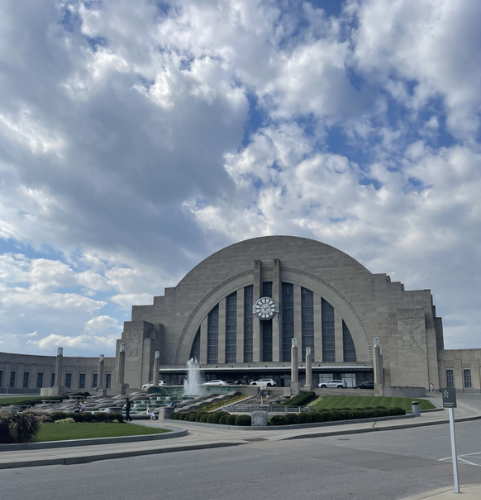
By Grace Campagna, Newswire Intern
The Cincinnati Museum Center and the Nancy & David Wolf Holocaust and Humanity Center are hosting an exhibition at Union Terminal, “Auschwitz. Not Long Ago. Not Far Away.”
The exhibition, which opened Oct. 18, contains “more than 500 original artifacts from the Auschwitz-Birkenau State Museum in Poland,” according to cincymuseum.org.
“I think the exhibit is spot on with the part of its title where it says, ‘not far away,’” senior sociology major, Interfaith Bridges Leaders Community board member and Cincinnati Hillel liaison Lindsay Rosichan said.
The site of Auschwitz-Birkenau is memorialized as a museum and promotes education, awareness and remembrance of the Holocaust’s solemn history and the lasting relevance of its consequences.
Auschwitz was “the largest of the German Nazi concentration camps and extermination centers,” according to the Auschwitz-Birkenau Memorial and Museum. There, approximately 1.1 million people lost their lives, 90% of whom were Jewish. Included on the grounds of Auschwitz was the main camp, Birkenau, 40 camps and sub-camps. The exposition by the Cincinnati Museum Center contains artifacts from all three divisions of the Auschwitz complex.
The exhibition at Union Terminal is an opportunity to bear witness and be a part of the living remembrance of the history of the camp. Included in the display of more than 500 original artifacts are “concrete posts that were a part of the fence of the Auschwitz II-Birkenau camp; fragments of an original prisoners’ barrack from the Auschwitz III-Monowitz camp; a gas mask used by the concentration camp officers and personal items including shoes, clothing, children’s dolls, eyeglasses and suitcases,” according to the Cincinnati Museum Center.
The location of the display, Union Terminal, also bears great historical significance. Housing the Nancy and David Wolf Holocaust & Humanity Center, Union Terminal is where many survivors of the Holocaust arrived by train to Cincinnati.

The exhibit features artifacts from the concentration camp, including clothing, fences and personal items such as family photos.
“Remembrance is perhaps the last key that we have, to understand and imagine our own role today in the world that we are living in,” Director of the Auschwitz Museum Dr. Piotr M. A. Cywinski said. Cywinski’s point ties together the past and present, highlighting the significance of our part in both.
On display until April 12, 2026, the exhibition at Union Terminal “is not just about what happened, it’s about what we do with that history today, how we respond to hate, how we build understanding and how we find courage in our own time,” CEO of the Nancy and David Wolf Holocaust and Humanity Center, Jackie Congedo said. “I think that having a place where people can reflect on the past is essential for a brighter future,” Rosichan said.