Opinions and Editorials Section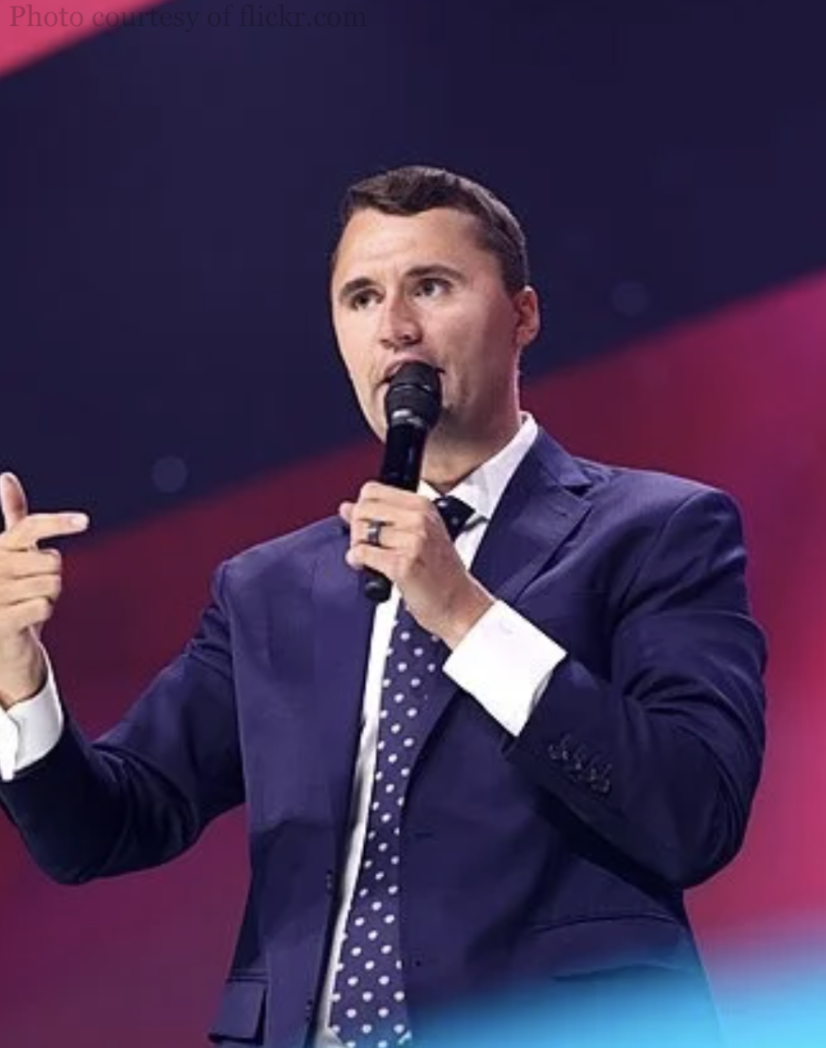
By Leah Barnard, Guest Writer
Following Charlie Kirk’s death, he has since been remembered by many prominent figures as a champion of free speech and a conscientious voice in American politics. However, this description requires a remarkable degree of selective memory and ignorance to many of Kirk’s talking points and infamous debates from previous years.
Kirk’s prominence in American politics has revealed how provocation and unrestrained speech have become a substitute for moral responsibility and respect in political discourse. Instead of elevating conversations, Kirk thrived on outrage, vilifying marginalized groups and amplifying a pre-existing polarized political climate. The tragedy of Kirk’s death cannot negate the reality that his legacy is a blueprint for division and hatred in American politics.
Kirk’s organization, Turning Point USA (TPUSA), is notorious for hosting culture-war-focused events on college campuses, often framing universities as strongholds of liberal indoctrination. At TPUSA events, Kirk would often film and feature antagonistic exchanges with progressive students constructed to show him “owning” them with conservative talking points.

Kirk staged a “Prove Me Wrong” table where he said “White Privilege is a myth and a lie. It should be completely destroyed. It is a racist idea.” at Colorado State University in 2018. The clips posted following this event, similar to many TPUSA events, showed Kirk “owning the libs;” yet the setup itself ensures a shock-factor among students and the generation of viral confrontation.
By design, Kirk’s events have fostered hostility in political spaces among young people where genuine debate is already precarious. The deliberate escalation of conflict intensifies partisan tensions, making casual attempts at discourse become overshadowed by the desire for a fierce response.
Beyond the immediate spectacle painted by TPUSA, there is an alternative motive at play: the normalization of conflict-driven messaging as a method of political socialization. Kirk’s legacy continues to inspire young people to view political opponents as enemies to defeat rather than opportunities for engaging critically with differing viewpoints. This approach will lead to a generation of polarized youth who value ideological loyalty over the pursuit of truth and empathy.
A major component to Kirk’s public persona was targeting marginalized groups in the name of protecting “traditional values.” Many of his statements went beyond political commentary, deliberately dehumanizing and undermining the lived experiences of communities that conflicted with or challenged his ideologies.
“We made a huge mistake when we passed the Civil Rights Act in the 1960s,” Kirk claimed in 2023 at AmericaFest. While he quickly followed by stating his opposition to this act lies in his disagreement with DEI efforts, it is claims like these that disregard historical context and diminish the impact this legislature has had on equality in America.

The debates held by Kirk only increased tension between college students and encouraged students to focus less on the facts and more on beating their opponent.
By labeling transformative legislation as a “mistake,” Kirk not only downplayed the advancements made towards equal opportunity, but placed doubt on the legitimacy of the systemic inequalities many minority groups in America have and continue to experience.
His statements regarding race often reframed these legal victories as a societal burden, suggesting that protection against institutional racism is inherently harmful to white, conservative Americans. Through this, Kirk mastered the weaponization of prejudice as a method for ideological gain.
The circumstance of Kirk’s death is undeniably tragic, but in acknowledging this, we should not be ignorant to his actions and detrimental influence on American politics. He was not a unifying figure and should not be recognized as a constructive individual for American society.
Kirk rallied up the young conservative population through his outspoken rhetoric that attacked marginalized groups, higher education and media in the name of maintaining traditional American values and free speech. Celebrating his legacy would be unjust to the groups he insulted and the ideals of productive civic engagement. Instead, his legacy is one we must confront rather than eulogize.