 Campus News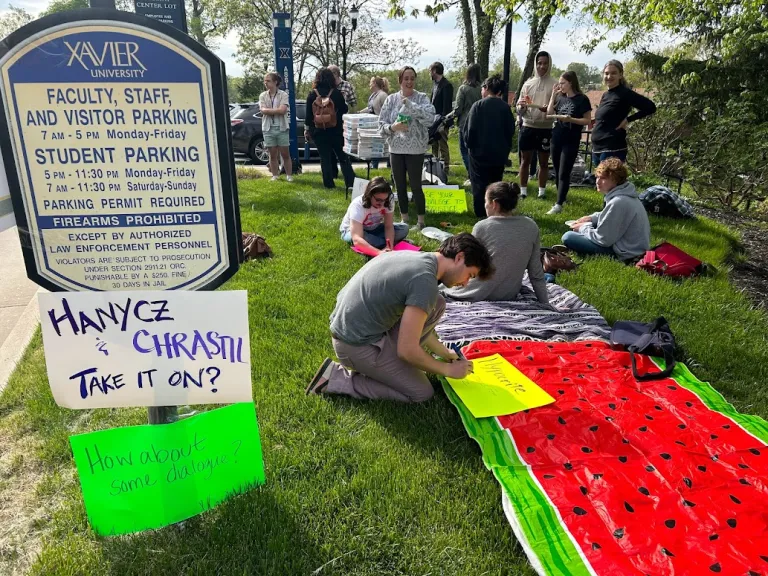
By Charlie Gainor, Staff Writer
Dr. Kimberly Moore, Vice President of Xavier Student Affairs announced a new policy last week that details guidelines for campus expression that students and clubs must follow.
“This fall will have a unique backdrop given where we are in our country’s presidential election cycle,” wrote Dr. Moore in a campus message to all Xavier students last Wednesday. “Elections and campaigns are wonderful times to, of course, exercise your right to vote, but also to make your voices heard and engage in expression on campus.”
The website included in the email has links to a series of resources, including a revised Student Lobbying, Political and Campaign Activities Policy which details guidelines on candidate endorsement, fundraising and advocating for voter registration.
“Students are encouraged to express their individual and collective political views provided they understand and make clear they are not speaking for or in the name of Xavier University,” the preamble of the policy reads. Seven sections follow that elaborate on interactions with elected officials, political candidates and political parties in regards to endorsement and hosting events.
“The Office of Student Involvement worked with the Director of Government Relations and our Chief Legal Counsel to make sure that we are in compliance with IRS regulations,” Dr. Leah Busam Klenowski, the Senior Director for Student Affairs said. “The updates to the policy are a result of that review.”
Section two of the document goes into detail on the rules behind club endorsements, whether it be parties, candidates or official ballot issues. Clubs are allowed to endorse or take a position on any of the three with clarification that the political views do not reflect the views of Xavier University. Clubs are not allowed to place signs, engage in on-campus solicitation, engage in fundraising or use University materials on behalf of an outside organization. This section of the policy is unchanged from the original release of the policy in 2021.

Major changes are detailed under section six “Voter Education and Registration.” Which reads that all campus voter registration drives now “must be conducted in a non-partisan manner,” with the presence of a candidate or campaign-related material not allowed at on-campus drives and all activities subject to the Hamilton County Board of Elections. The policy also forbids questionnaires “skewed to the advantage or disadvantage” of parties, candidates and ballot issues, as well as stating that all resources must be linked to non-partisan sites.
“Voter registration may not suggest who or how a person should vote,” Klenowski said. “Clubs can endorse candidates and participate in campaign related activities, but when clubs host voter registration, they cannot share an endorsement during that event.”
Klenowski named the website for the Board of Elections and the League of Women Voters as viable non-partisan resources to bring up at voting drives.
Klenowski also clarified that “ballot issues” simply mean official issues and not general points of contention. Under the policy, clubs are allowed to take a position on the issue, but are not allowed to bring that opinion to voting registration events.
“Clubs can and should discuss campaigns and create a space for students to reflect their views about the campaigns,” Klenowski said when asked about the scope of “non-partisanship” being enforced. “This is great to do in club meetings or events. The key shift is that any voter registration event has to be non-partisan.”
Also linked in the website sent out by Dr. Moore and the Student Affairs team are Xavier’s “Principles of Free Speech and Expression,” which prohibit the suppression of free speech on the basis of content or viewpoint, allow for the peaceful protest against speakers and campus views and encourages students to evaluate ideas “not by seeking to suppress speech or by engaging in ad hominem attacks, but by candidly and vigorously challenging the arguments and ideas they oppose.” The policy also clarifies that Xavier may restrict speech if it “violates the law, incites violence against individuals, groups or property,” violates the university’s policies against harassment and discrimination or “unjustifiably invades substantial privacy or confidentiality interests.” The literature of these principles has not been updated since their approval in 2022.
Dr. Moore encourages those who have questions to reach out to the Xavier Student Affairs team. “We want to make sure you know the practice of sharing your values, ideas and beliefs is encouraged and a valued part of the ethos of our University, as we deeply believe in free inquiry and engagement of diverse viewpoints and ideas on our campus,” Moore said.


