 Campus News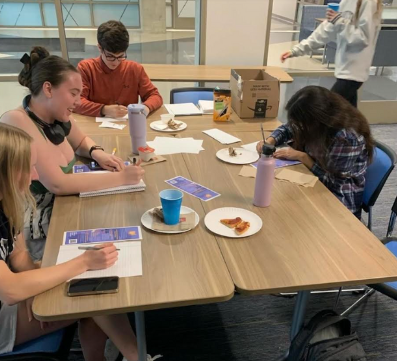
By Rieley McDonnell, Newswire Intern
Last Wednesday, Xavier’s chapter of the Ohio Innocence Project (OIP-u) hosted a letter writing campaign to advocate for the abolition of the death penalty in Ohio.
The event was held in the Health United Building and was co-sponsored by Criminal Justice Society, XU Democrats, Muskies for Life, Psi-Chi and the Center for Faith and Justice. At the event, there were guest speakers who talked about two different bills in the Ohio legislature that could impact people on death row.

Pierce Reed, the Director of Policy and Engagement for OIP-u, spoke to students about the implications of the death penalty on wrongfully convicted people who are on death row but innocent.
Pierce Reed, Director for Policy, Legislation and Engagement for the Ohio Innocence Project spoke about Senate Bill 101, which would abolish the death penalty in Ohio. The goal of the letters that attendees wrote was to get the bill to the Senate floor for a vote.
To get a bill to the Senate floor, it needs to pass through three committee hearings. As of writing, the bill has passed through two of three stages and now is waiting for a yes or a no from its final committee.
“Sometimes after a bill gets through one or two hearings, it kind of falls into a sort of purgatory and gets lost. But every bill should at least have the opportunity to be heard,” Reed said.
Another bill students were educated about was House Bill 392, which, if passed, would add nitrogen hypoxia as a legal method of execution. Advocating against the passage of House Bill 392 was Deputy Director of Ohioans To Stop Executions Kendall White. White shared that when nitrogen hypoxia was first used in the execution of Kenneth Smith, it was botched.
“Smith, who was on a gurney, appeared conscious for ‘several minutes into the execution,’ and ‘shook and writhed’ for about two minutes after that, media witnesses said in a joint report,” a CNN article reported.
Students wrote letters to Ohio Senate Judiciary Committee Chair Nathan Manning and Vice Chair Michele Reynolds, legislators in charge of the committee where Senate Bill 101 currently rests. They control whether the bill will move to the Senate floor for a vote.

At the event students were given the information needed to be informed about the death penalty, but ultimately told to write from the heart and tell Ohio Senate Judiciary Committee Chair Manning and Vice Chair Renoylds why they personally believed the death penalty needs to be abolished in Ohio.
“There are currently about 5% of people on death row who are innocent, which may seem like a small number, but when you think about it each of those lives adds up. There is a high risk that we execute someone who was innocent,” Reed said.
“I believe that the death penalty is an unjust punishment that has too much risk,” first-year Philosophy, Politics and the Public (PPP) major Jacob Wineinger said.
The program director for Ignite Peace, Bekky Baker, echoed Wineinger and mentioned other reasons why people might be against the death penalty.
“At Ignite Peace, we believe that people are more than the worst thing they have ever done,” Baker said.
Oliva Turner, a student at the University of Dayton, is on the board of Dayton’s chapter of OIP-u as a social media advocacy consultant. She told Xavier students in attendance how social media could be used as a tool to enact change and put pressure on politicians.
Turner talked about the hashtag “#nodeathpenaltyohio,” which can help boost people’s posts about the subject to users who would not normally see their posts. She told students to tag Chair Manning in any post that they made about Senate Bill 101 in hopes to make him aware that people care about the topic.
“When we work together, we can make anything happen,” White stated. “The use of social media as a tool to draw the attention of politicians is one way a community can work together to make change.”
Senate Bill 101 and House Bill 392 are up to the legislature to pass, but citizens can get in touch with Ohio representatives to influence how they will vote.


