Local News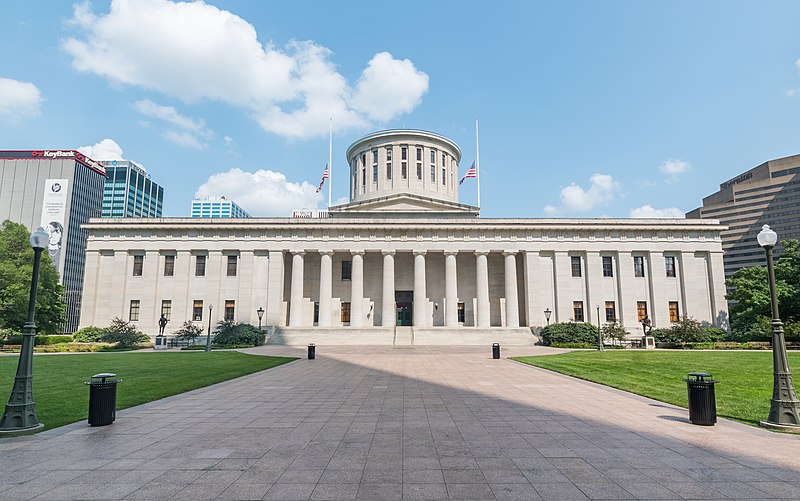
By Jackson Hare, Education and Enrichment Coordinator
An Ohio bill banning transgender students from using bathrooms that align with their gender identity now awaits action from Governor Mike DeWine, who can either sign it into law or veto it after it passed the Ohio legislature on Nov. 13.
The measure, named the Protect All Students Act was attached to a bill that would amend sections of the existing college credit plus program in Ohio.
The bill, numbered Senate Bill 104 in the Ohio Senate and House Bill 183 in the Ohio House, applies to both public K-12 schools and institutions of higher education and requires schools to designate separate bathrooms, locker rooms and overnight accommodations for males and females, based on their sex assigned at birth.
The bill does not apply to employees, people helping young children or those assisting individuals with disabilities. Moreover, schools would still be able to provide single-use and family restrooms, but cannot provide spaces that are designated as gender-neutral.
A decision on whether or not to veto the bill from DeWine is expected by Monday, Nov. 25.
Bill sponsors Sen. Jerry Cirino (R-Kirtland) and Sen. Andrew Brenner (R-Delaware) posit that the bill is about “safety and security.”
Opponents of the bill, including the ACLU of Ohio, have urged the governor to veto the bill.
“If allowed to go into effect, SB 104 will create unsafe environments for trans and gender non-conforming individuals of all ages,” ACLU of Ohio policy director Jocelyn Rosnick said.
“I do think that concern has a lot of validity,” Xavier University Chief Title IX Officer Kate Lawson said.

This bill would enforce gendered bathroom usage in accordance with students’ sex assigned at birth
“I have a lot of questions about the state law that I don’t think are answered around logistics. How is this enforced? And those are questions that we want to look at very carefully, grounded by our mission and our values, to ensure that if this becomes law, that it is not weaponized or used to cause harm on this campus. That’s not going to fly here.”
To respond to the narrowing of Title IX provisions in 2020, when the Trump administration adapted the language to exclude gender identity from the Title IX protections, Xavier created a parallel set of policies under the student handbook that contains a broader definition of sex discrimination. If the bill passes, Lawson assured that Xavier will maintain its policies.
“There are components of that law (Title IX) which are challenging and not aligned with what we see as best practices, and we have still prioritized equitability and the dignity of students,” Lawson said. “Whatever happens here with the state law, that’s still going to be our approach.”
Lawson contended that there is still some uncertainty regarding the bill’s applicability and enforceability, as well as whether or not it will pass. DeWine has previously vetoed a ban on gender affirming care for minors, but has said previously he would sign the bill but will conduct a legal review first.
If the bill passes, Xavier may have to rename or relabel the 13 gender neutral bathrooms on campus to comply with the new law.
Lawson encourages students to “make their voices heard” if the bill passes.
“I would really encourage Xavier students to ask questions, to demand answers, to talk to each other, because this is your community,” Lawson said. “Just because something is written in law doesn’t mean we can’t challenge it as a community in dialogue and in action.”