Opinions and Editorials Section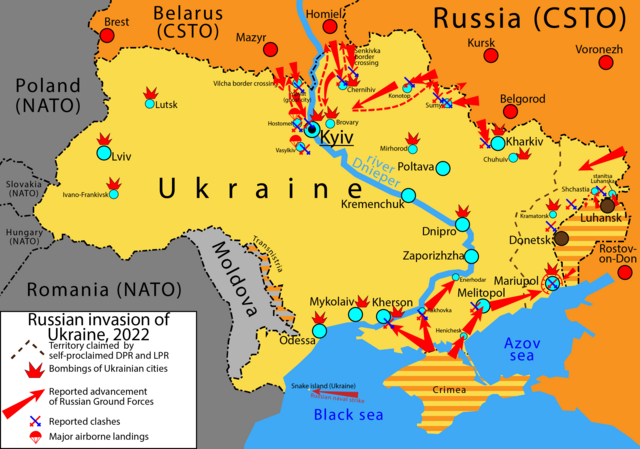
By Charles Leighton, Guest Writer
Following Secretary of State Marco Rubio’s arrival in Riyadh to meet with Russian diplomats on Feb 17, many are wondering what it will take to end the war in Ukraine. With at least several hundred thousand dead and total casualties likely approaching millions, there is no justifiable reason to prolong this devastating war. The war in Ukraine should end as quickly as possible, which will likely include cession of Ukrainian territory to Russia and the exclusion of the European Union from peace negotiations.
Over the past three years, both the EU and NATO have failed to facilitate a resolution to the conflict. As a result, the United States should continue to pursue peace in Eastern Europe without the involvement of either organization.
As Russia has continued its conquest in Ukraine for this long, Russian President Vladimir Putin has little respect for many European nations and would likely continue to disregard demands from the EU. For example, the EU has called for Russia to completely withdraw from Ukrainian territory.
While ideal, this proposal does not offer a practical and swift resolution to the war, but still further pits men against one another in a senseless war. If these entities continue to rely on idealism without offering practical solutions, they should be ignored in the coming phase of negotiations.
Furthermore, Ukraine will likely have to face that the relinquishment of its ethnically Russian territories is a matter of when, not if. These areas have historically been more closely aligned with Russia than with Ukraine, making them more inclined to join the Russian Federation.
While this will be an undesirable decision for Ukraine, it is the most feasible path forward, as Russia is unlikely to end the conflict without territorial gains. Recognizing these regions as culturally and ethnically Russian would not only reflect historical realities but also help to bring about a prompt resolution to the war.
Some people have been quick to dismiss these criteria for peace, likening them to the appeasement of Hitler by Neville Chamberlain during World War II. The criticisms are inaccurate because the entire point of the appeasement of Hitler by the British was to avoid a war, whereas the purpose of ceding Ukrainian territories to Russia is to end a war.

When Chamberlain permitted Hitler’s capture of Austria, Czechoslovakia and Lithuania with little resistance, it signaled his commitment to avoiding an all-out war with Nazi Germany. This poor decision was Britain’s attempt at preventing a chaotic and bloody war against the very powerful German Third Reich.
The current discussions surrounding peace in Ukraine seek to end a brutal war as quickly as possible, as to not prolong the suffering of civilians. Further, German aggression was heavily motivated by the belief in the racial superiority of the Aryan people. Russia’s motives are not ones of racial or ethnic superiority, but are most often seen as attempts by the nation to maintain strong influence in Eastern Europe.
Ultimately, the question of peace is a question of the greater good, lives, or land. The Ukrainian people have been subjected to a brutal invasion by Russia and have put up a remarkable fight. That being said, in the interest of a timely end to the war, Ukraine will be forced to make some concessions that will hurt, but will also save lives.