Local News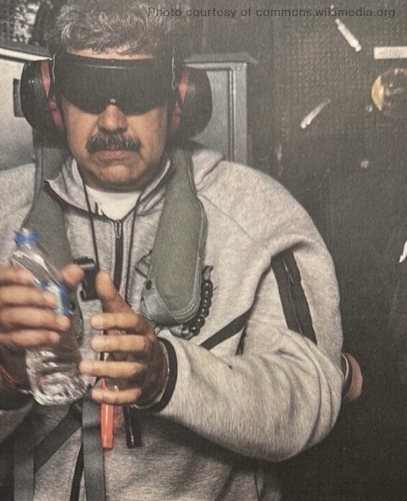
By Rory McNelley, Education and Enrichment Coordinator
In the early morning hours of Jan. 3, President Donald Trump initiated Operation Absolute Resolve to capture and later prosecute Venezuelan President Nicolas Maduro and his wife Cilia Flores in Caracas. The couple is facing numerous charges in federal court including narcoterrorism and drug trafficking charges. Both have entered a plea of not guilty.
“I’m innocent. I’m not guilty. I’m a decent man,” Maduro stated in federal court in Manhattan on Jan 5. He was read his constitutional rights by the judge and stated that they had not been shared with him prior to the court date.
President Trump held numerous press conferences explaining the U.S. military operation’s success. He claimed that due to Venezuela’s flow of drugs into the United States, Maduro was responsible for the death of hundreds of thousands of Americans. He was captured by U.S. military and law enforcement and transported to face federal prosecution.
Trump stated in his press conference that the U.S. would govern the country until a new leadership could be established. When questioned for the details, none were provided.
Venezuelan opposition leader and Nobel Peace Prize laureate Maria Corina Machado presented her Nobel Peace medal to Trump as a “personal symbol of gratitude” for his actions in the country. The Nobel Peace Prize committee stated the honor is nontransferable.
Questions remain unanswered as to the future of Venezuela including who will rule. Trump is focused more on the oil industry in the region. “American oil was stolen,” Trump said at a press conference, where he explained that the Venezuelan government had tampered with U.S. oil companies’ processes in the region.
Trump stated that Venezuela should turn over 30 to 50 million barrels of oil to the U.S. to be sold at market price for the benefit of both countries. Trump stated that the oil drilling will be controlled by the U.S. and that the oil infrastructure would be rebuilt using money from U.S. oil companies. Framed as an investment in the country’s economy, Trump has repeatedly claimed he plans to revive the oil industry in the region.
Reactions to Trump’s action against Maduro vary across the region and the world. Some citizens of Venezuela have taken to the streets to call for the return of their ruler while many Venezuelan citizens that have been exiled by the government have celebrated the capture. Regions in the U.S. where many Venezuelan migrants are present held celebrations.
American citizens have voiced concern about the military action across the country.
Protests in Washington D.C. and other cities call the intervention illegal. Signs outside federal court buildings in New York where the trial is set to take place read, “Hands off Venezuela.” Reactions on social media reflect disbelief that the president would take action to remove a sitting foreign leader.

Some U.S. lawmakers support the intervention because of Maduro’s alleged connection to narcoterrorism and its effects on the American population. Others contend that Maduro’s drug trafficking is only an excuse for America to profit off untapped oil reserves in the region.
Maduro and Flores have been arraigned in federal court on charges including drug trafficking and money laundering. Both defendants pleaded not guilty. Maduro stated his opinion on the intervention calling it an unjustified kidnapping. Flores’ lawyers have raised questions as to injuries she sustained during the capture.
Their next hearing is scheduled for March 17 of this year. Major legal battles are expected and questions over presidential immunity have been raised by Maduro’s lawyers.