 Campus News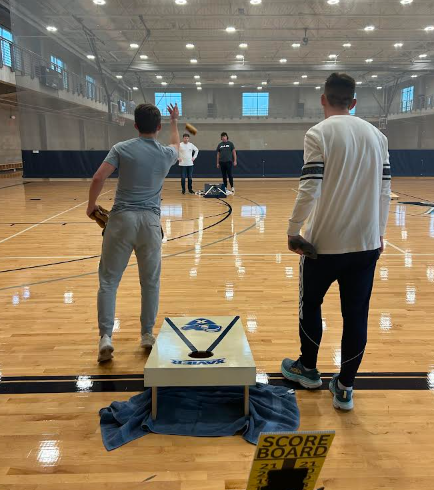
By William Coffman, Opinion & Editorials Editor
“Cornhole embodies everything that you go through in life,” Robert McClendon said. “Pain, hurt, joy, competitiveness. It goes through all that. It helped me get through the loss of a family member, into a safe space, away from bars and clubs, it’s been a safe place.”
Xavier’s chapter of the Ohio Innocence Project (OIP) partnered with Pre-Law Society, Criminal Justice Society and Psi-Chi to host a cornhole tournament Sunday at the Health United Building (HUB).
Participants were encouraged to donate $5 to join the bracket, with the money going towards the Berry-Godsey Phoenix Initiative for the assistance of exonerees as they transition out of prison.
Competitors were joined at the event by McClendon, an exoneree who spent 18 years in prison until DNA testing proved his innocence. McClendon introduced the event and spoke on why cornhole was the chosen sport.

Students gathered to celebrate Ohio Innocence Project (OIP) exoneree, Robert McClendon and the work OIP does with a fundraising cornhole tournament on Sunday.
Sophomore criminal justice major and board member for OIP Ta’Mia Stanley further elaborated on the idea of the cornhole tournament and what OIP hoped to achieve through it.
“I think it’s important because we get to show people what we do as a group while also having something fun,” Stanley said.
The event had a sizable crowd gather on the basketball courts of the HUB to partake in the tournament. Ultimately, it was McClendon and Xavier’s OIP-u President and junior English and advertising double major Clare McKinley who came out on top, conquering the rest of the bracket.
The organizers kept the exonerees and the goal of assisting them at the forefront of attendee’s minds.
The sign-in table highlighted the Berry-Godsey Phoenix Initiative, which supports exonerees of OIP upon their release from wrongful imprisonment. The funds go towards items such as clothing, toiletries and other essentials that assist them in navigating their release.
When not tossing bean bags, McClendon could be found telling students about his story. He discussed why events like this hold an important place in his heart and why they are critical to understanding exonerees and their struggle.
“Sometimes, when you get out of prison, you are still in prison. It’s just a new prison,” McClendon said. “A prison in terms of relationships, family, friends, things like that, it’s a new type of relationship and you have to adjust, and it’s hard.”
The United States Department of Justice has studied the transition period McClendon spoke about. They have found that ex-prisoners, whether they were innocent or guilty, struggle with the adjustment of returning to normal life, and frequently find themselves returning to a jail cell.

The Bureau of Justice Statistics in a 2021 report outlined the reentry data, showcasing how “about 66% of persons released from state prisons across 24 states in 2008 were arrested within three years after release, and 82% were arrested within 10 years.”
Actions such as the Second Chance Act, signed into law by President George W. Bush, and charitable groups like the aforementioned Berry-Godsey Phoenix Initiative, work to help reduce these re-entry rates, but the data indicates there is still work to be done.
McClendon believes that another way to assist is simply giving exonerees a voice to share their stories and help the public better understand what it is like from the exoneree’s perspective.
“Learning about the exonerees, I think it’s important that we understand the stories, their situations. Just seeing what happened, how they contended with their situations, it’s important. That’s why I come to these events,” first-year international studies major Jayden Richardson said.


